
You gave everyone on your team an AI agent. Why isn’t the team moving faster?
The old scarcity was developer hours
For twenty years, the constraint on a team was simple: how much can the people who can write code actually build. Roadmaps were long because hours were scarce. Every team’s real bottleneck sat in the same place, so every team’s operating model was built around the same fix: hire more, prioritize hard, protect focus time.
Agents changed the supply side of that equation almost overnight. One person with an agent can now draft the plan, write the code, chase the follow-ups, and summarize the meeting, all in an afternoon that used to take a week. The old scarcity is going away.
The new scarcity is context and judgment
But speed at the individual level does not add up to speed at the team level. It fragments it.
Five people each running their own agent produce five times the output and five separate versions of what’s true. Nobody has the full picture. Decisions get made twice. The same question gets answered differently by two different agents on the same afternoon, because neither one had the same context. The tax used to be “not enough hours.” Now it’s “not enough shared context,” and that tax shows up as meetings, re-explaining, and work redone because nobody noticed it had already been done.
Individual agents make people faster. They do not, by default, make a team coherent. In fact, they usually amplify the fractures and dissonance already inside an organization, surfacing the inefficiencies and team dynamics people were already struggling with.

AIOS is the coordination layer
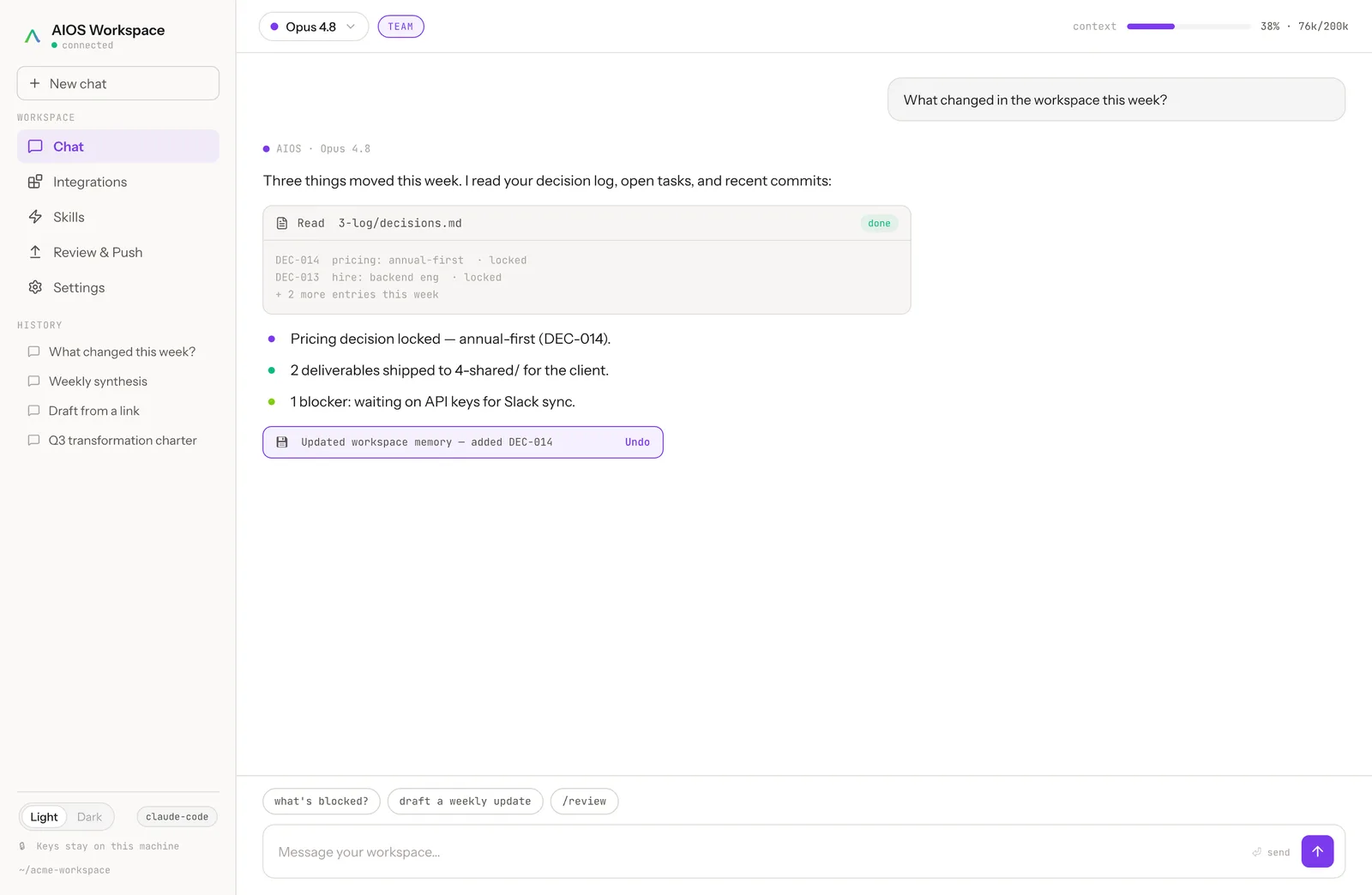
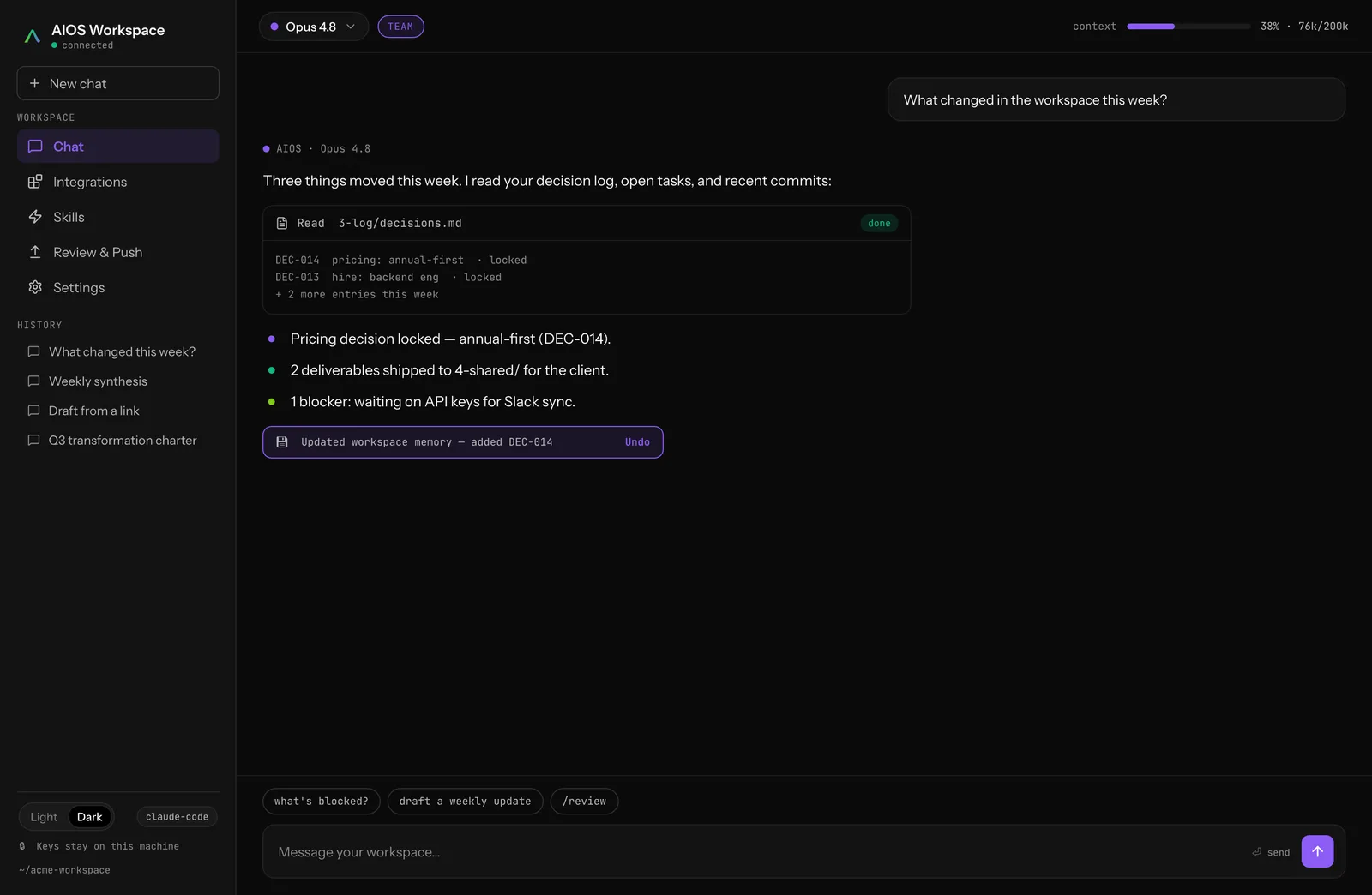
AIOS is built on a simple idea: give every person a structured workspace, and give the team one shared brain, so agents can move faster without the team losing context, focus, or control.
There are two parts and one loop:
- Individual workspaces: person plus agent, private by default, where the actual work happens. Nothing is shared without you choosing to share it.
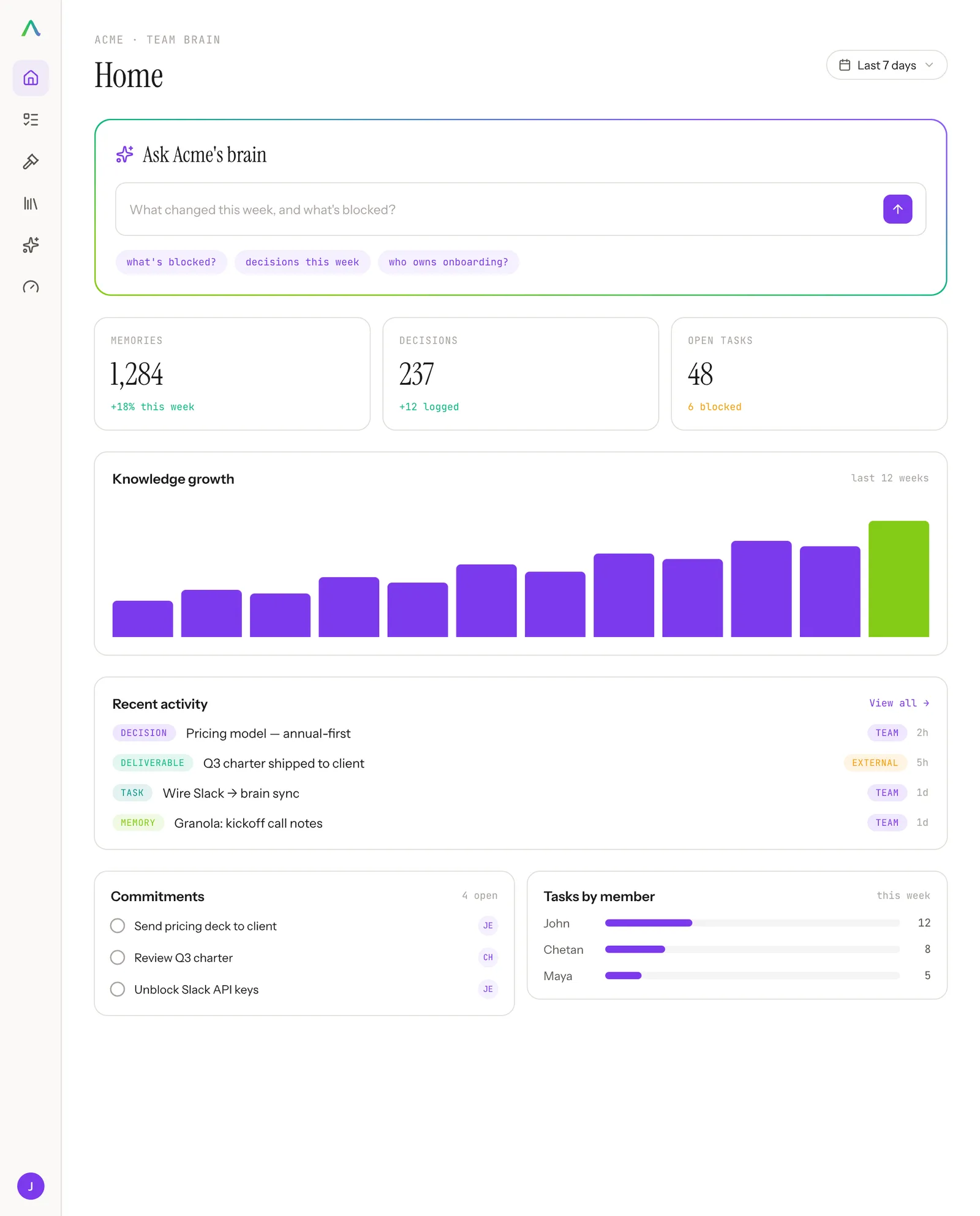
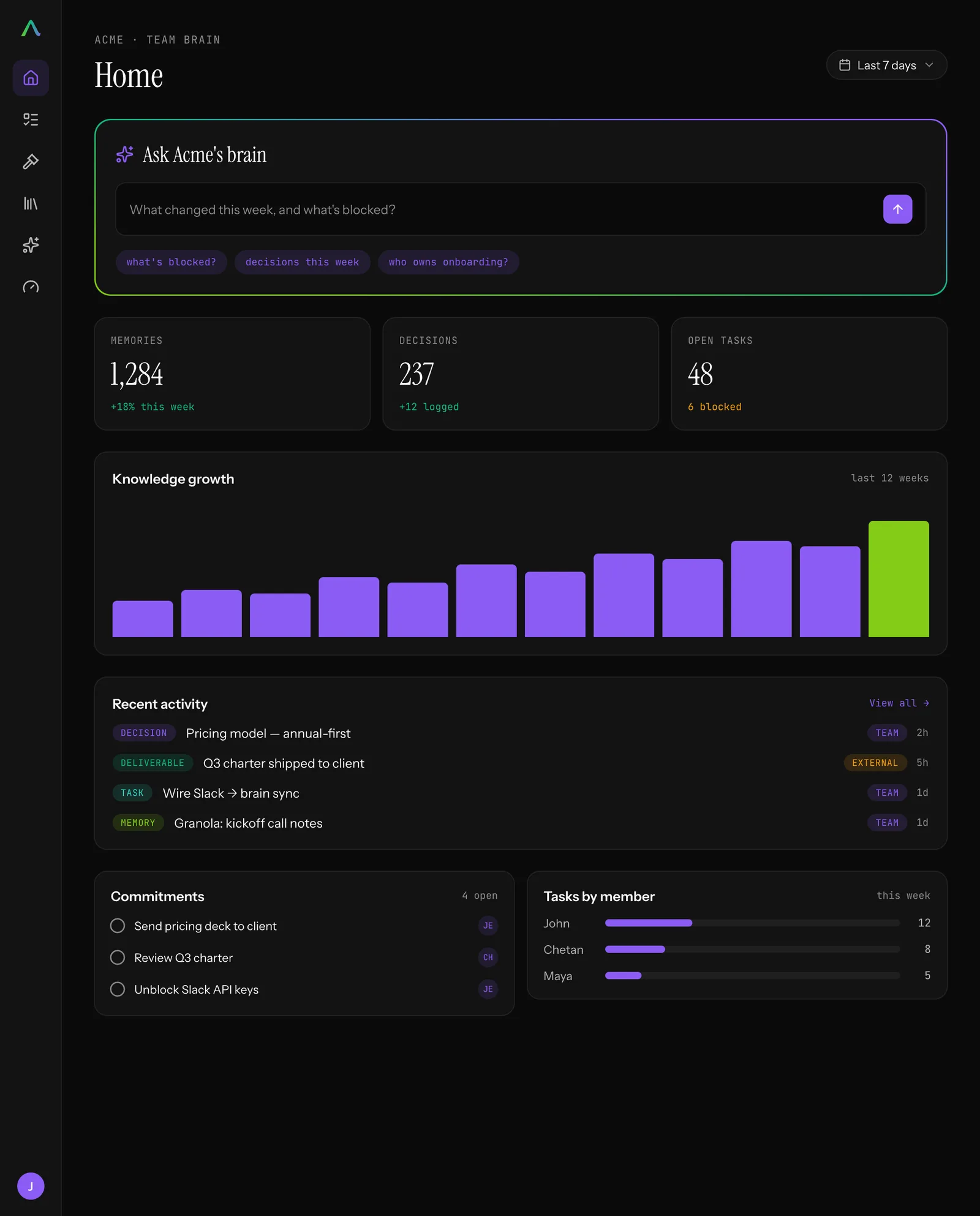
- Team Brain: one shared memory the team can ask questions of. Decisions, tasks, and context land here as people work, not as a separate reporting chore.
Work flows up from the workspace into the brain. Understanding flows back down. Neither half does much alone: a brain without individual workspaces or integrations is empty, and a workspace with nothing to draw on re-explains the company from scratch every time.
What we learned building it
We built AIOS after helping transform several companies into AI-native organizations. This usually begins with a founder or executive coming to the conclusion that “if we don’t become AI-native and our competitors do, we will quickly become obsolete.”
AI transformation isn’t as simple as handing everyone in the organization a Claude, Cursor, or ChatGPT license. Each department has different needs and workflows, but they all share the same organizational context. Across those engagements, a pattern kept emerging in the market as a whole: a “second brain,” first for individuals to manage their own context, then for teams, a “company brain.”
Bring those two systems together and the flywheel compounds. A non-technical user can fire up their workspace and manage their documents, email, and calendar in an easy, conversational style. The privacy-first architecture keeps a human in the loop at all times, so only the context someone chooses to share is surfaced to the team brain from an individual workspace.
Learning loops grow the flywheel from there. As people build skills, hooks, and guards to improve their own workflows, the best patterns eventually surface to the team brain. Week one, it reads your inbox and drafts a reply. By week six, it has learned the shape of your week and starts proposing the recurring work itself, scheduling sweeps, follow-ups, stakeholder check-ins, because you didn’t have to hand it a workflow and ask it to comply. It noticed what kept recurring and built around you.
Try it
AIOS is AGPL-3.0-only licensed and self-hosted. One workspace per person runs locally on their machine (or on a VPS via Hermes / OpenClaw), and the team runs the brain on their own Postgres. No cloud lock-in, no signup wall just to see how it works.
We’ve opened it to a small public cohort. If you work with agents and want a structured workspace plus a shared team brain, try the quickstart:
- Copy the setup prompt from the quickstart guide.
- Paste it into Claude Code. It inspects your setup first, then tells you what it found.
- Approve each step. Nothing is installed or connected without your yes.
What we’re looking for: people looking for a way to manage context and agents across a team.
Where it’s rough today: limited integrations (GitHub, Linear, Slack, Granola, and ClickUp), with more coming soon. Pull the repo, build your own integration, and push it back to the community.
Read more: Introducing AIOS · quickstart, docs, and source at github.com/aiosbrain.