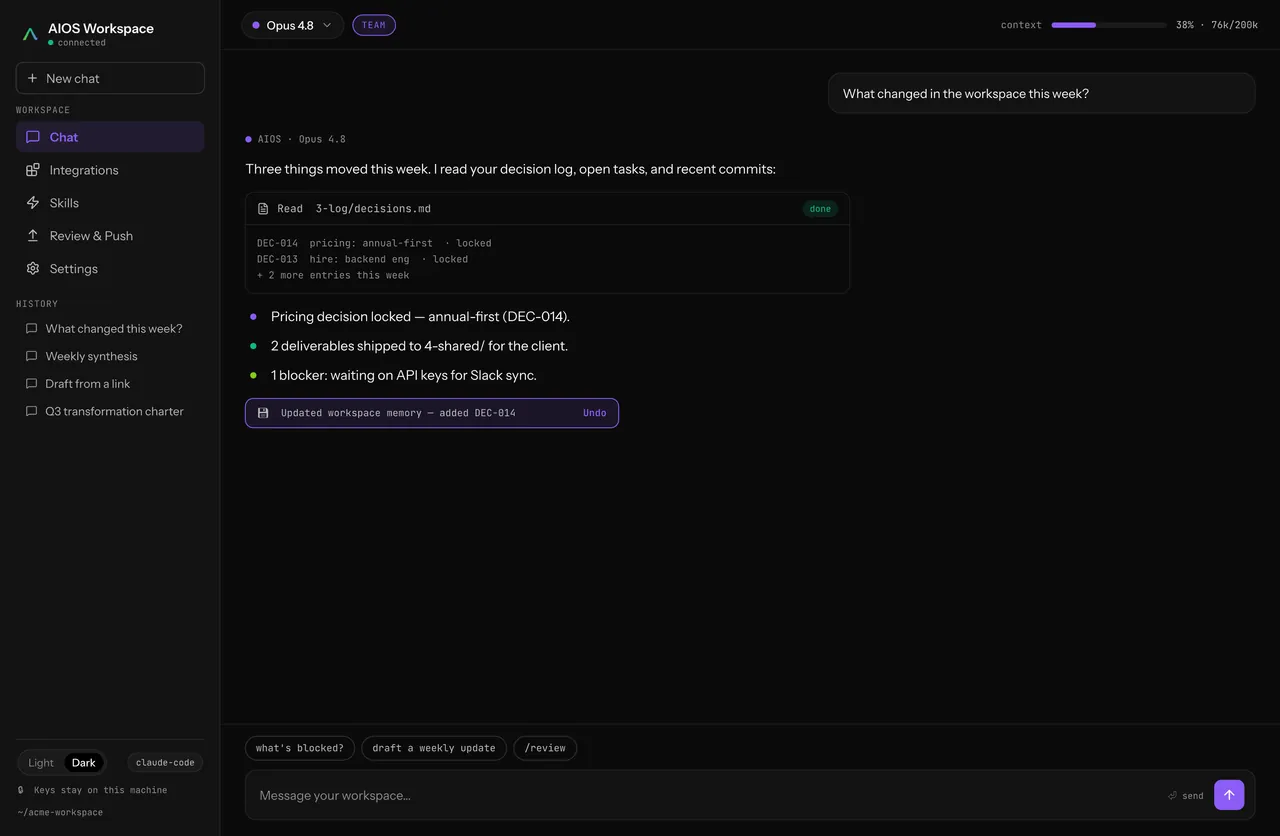
MIT Licensed. Self Hosted. Private by default.

The operating system for teams of humans and agents. Open source.

Every person gets a private, governed workspace that runs your team's shared standard, and nothing leaves it unless you push. Everything they do push becomes one team brain, queryable in plain English.

A recording: you paste the setup prompt into a coding agent, it clones the toolkit, asks which context you work in, and builds your workspace — six numbered folders, three of which never leave your machine.
  1. $ claude
  2. > Set up AIOS on this machine as a careful onboarding guide. +29 lines
  3. read — inspect, explain, choose, validate, then stop
  4. inspecting — aios onboard --inspect --json · read-only
  5. found — no workspace and no toolkit on this machine
  6. explained — first run · starting from a clean machine
  7. your turn — Personal / Join / Create?
  8. Personal · keep it standalone
  9. Join · connect an existing brain
  10. Create · deploy Team Brain on Railway
  11. > Join
  12. cloned — aios-workspace · dependency-free scaffolder, no packages installed
  13. previewed — 6 folders to create · nothing written yet
  14. your turn — scaffold exactly this?
  15. waiting · nothing is written without approval
  16. > approve
  17. scaffolded — my-workspace · 6 folders, 3 access tiers
  18. the six folders: 0-context (team), 1-inbox (private), 2-work (team), 3-log (private), 4-shared (external), 5-personal (private)
  19. private — 3 of 6 folders never leave this machine
  20. normalized — https://brain.example.com/t/acme to https://brain.example.com
  21. your turn — trust and save this exact Brain origin?
  22. waiting · the URL is not trusted yet
  23. > approve exact origin
  24. validated — GET /api/v1/me · team acme, member tier
  25. ready — workspace connected in under 15 minutes
  26. held — no push performed · sharing remains a later choice
  27. next — aios status · review what is local, blocked, or eligible
Read the full docs →

Closed platforms are racing to build this. We are building it in the open.

  • Claude Code
  • Codex
  • Cursor
  • Conductor
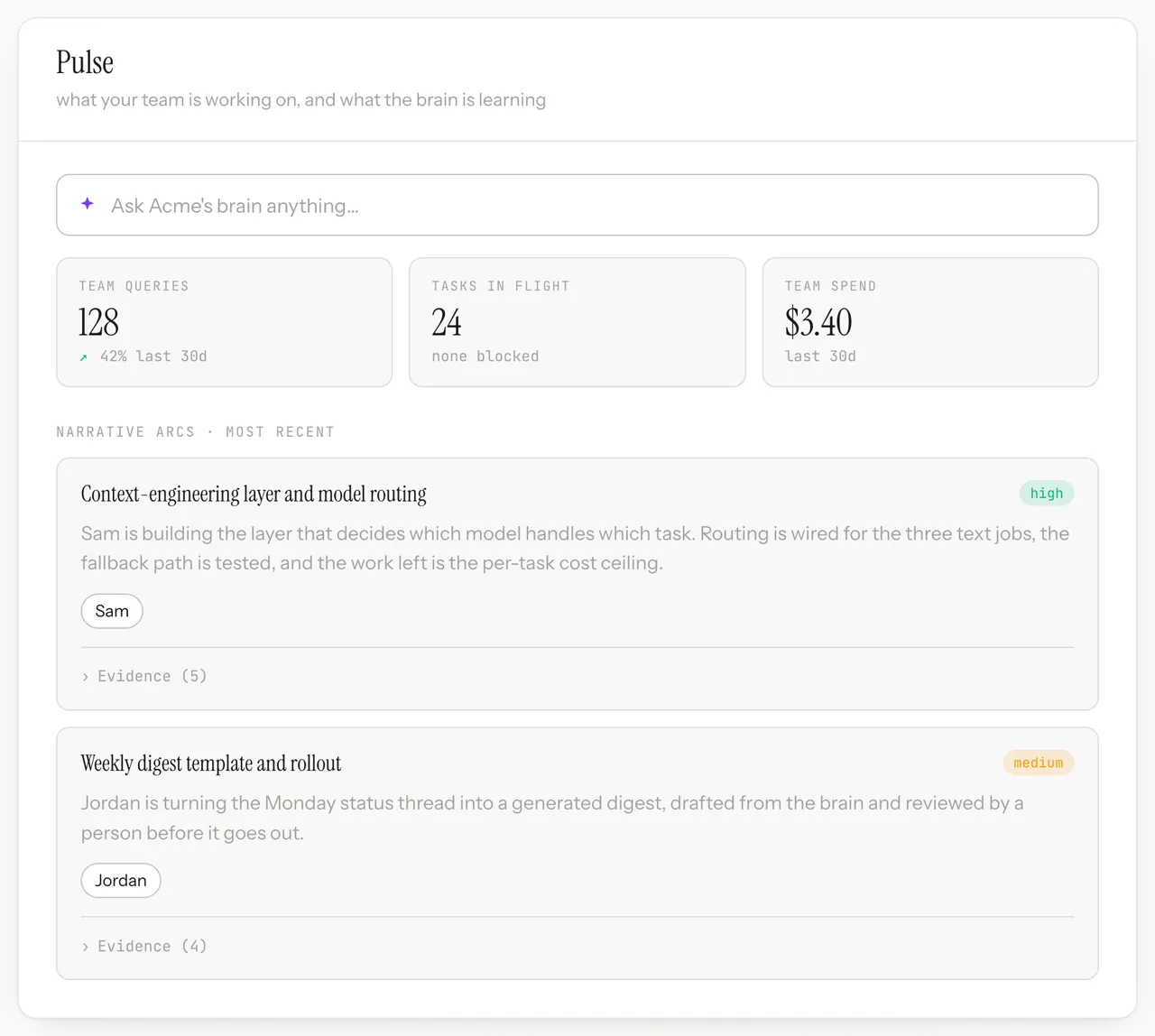
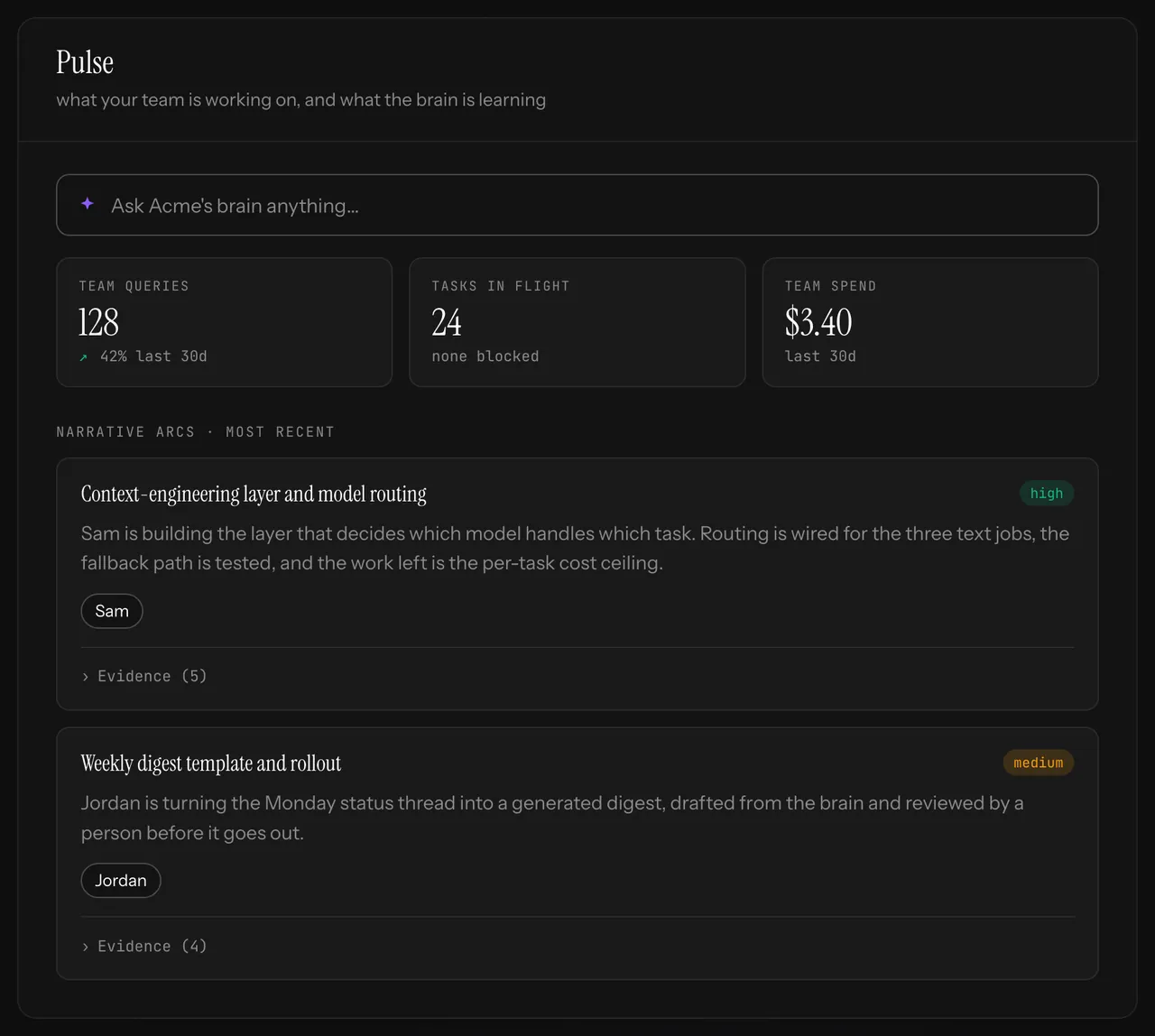
The AIOS Team Brain Pulse dashboard: a plain-English query bar, team queries, tasks in flight and spend at a glance, and the most recent narrative arcs the brain wrote about what each person is working on
Team Brain: what the team is working on, written by the brain
10 Tools connected. Chat, code, docs, meetings.
3 Privacy tiers. Private by default.
100% Open source. MIT licensed.
THE SHIFT

Your competitors are going agentic. Are you?

Every team now has the same models. The edge is no longer who has AI, it is who has turned it into how the whole company runs. A fully agentic company ships faster, coordinates without meetings, and compounds what it learns, while everyone else is still pasting prompts into a dozen disconnected chats.

  1. 01

    Every person ships like a team.

    Agents draft, build, research, and review next to each person, so the same headcount produces a multiple of the output. The teams that have wired this in are already pulling ahead, and the gap widens every week.

  2. 02

    The company coordinates itself.

    When every workspace feeds one shared brain, nobody spends their day reconstructing what everyone else did. Work stops colliding, hand-offs stop stalling, and no one needs a meeting to see where things stand.

  3. 03

    Every day compounds.

    The work writes itself down: prompts, decisions, and outputs become shared context instead of dying in someone's head. Your company gets sharper with every use, and that lead is one a competitor cannot copy overnight.

Going agentic is not a tool you adopt. It is how the next wave of companies will run, and the teams building it now are the ones you will be up against.

Set up your workspace →
THE WEEK

What everyone did, without anyone writing it up.

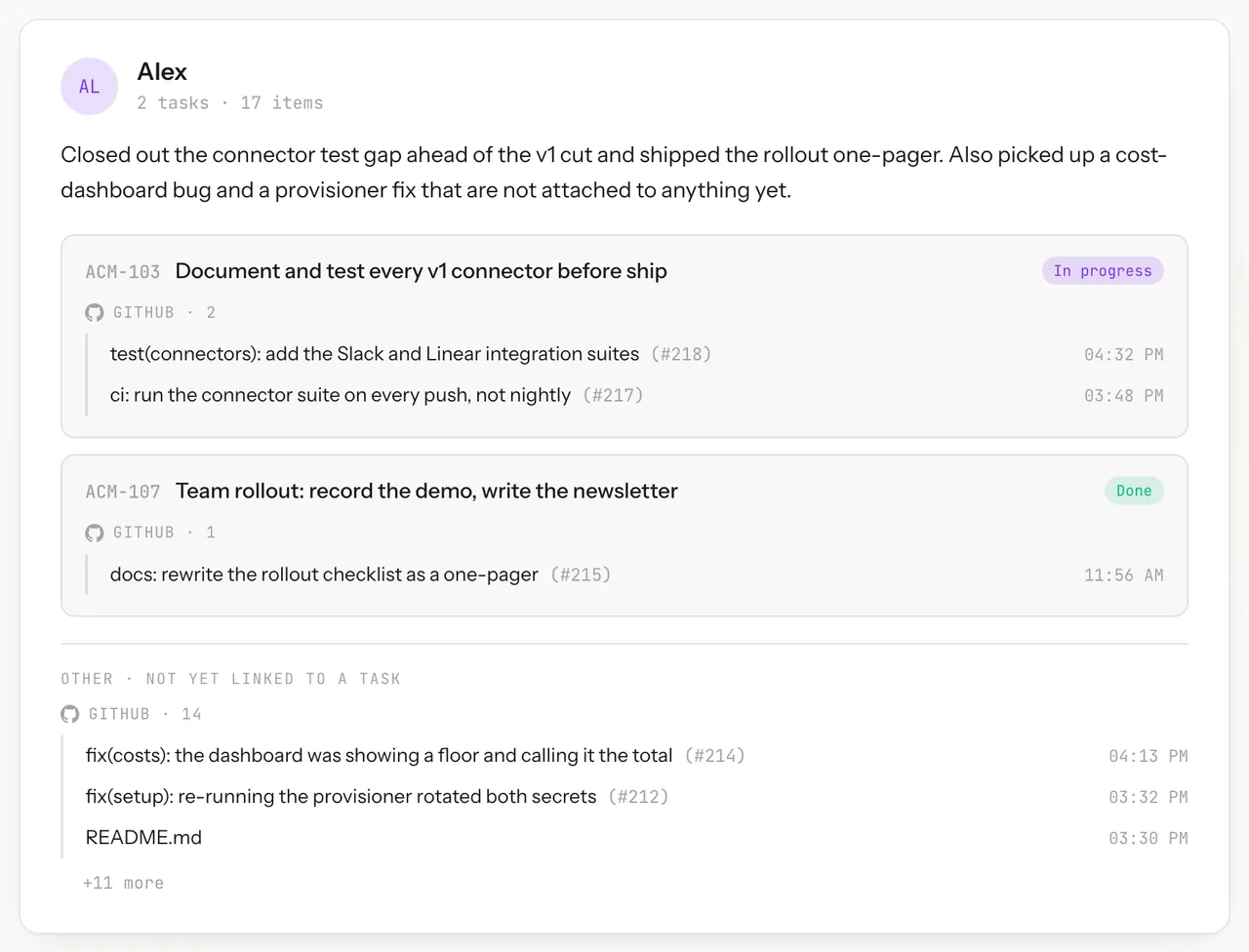
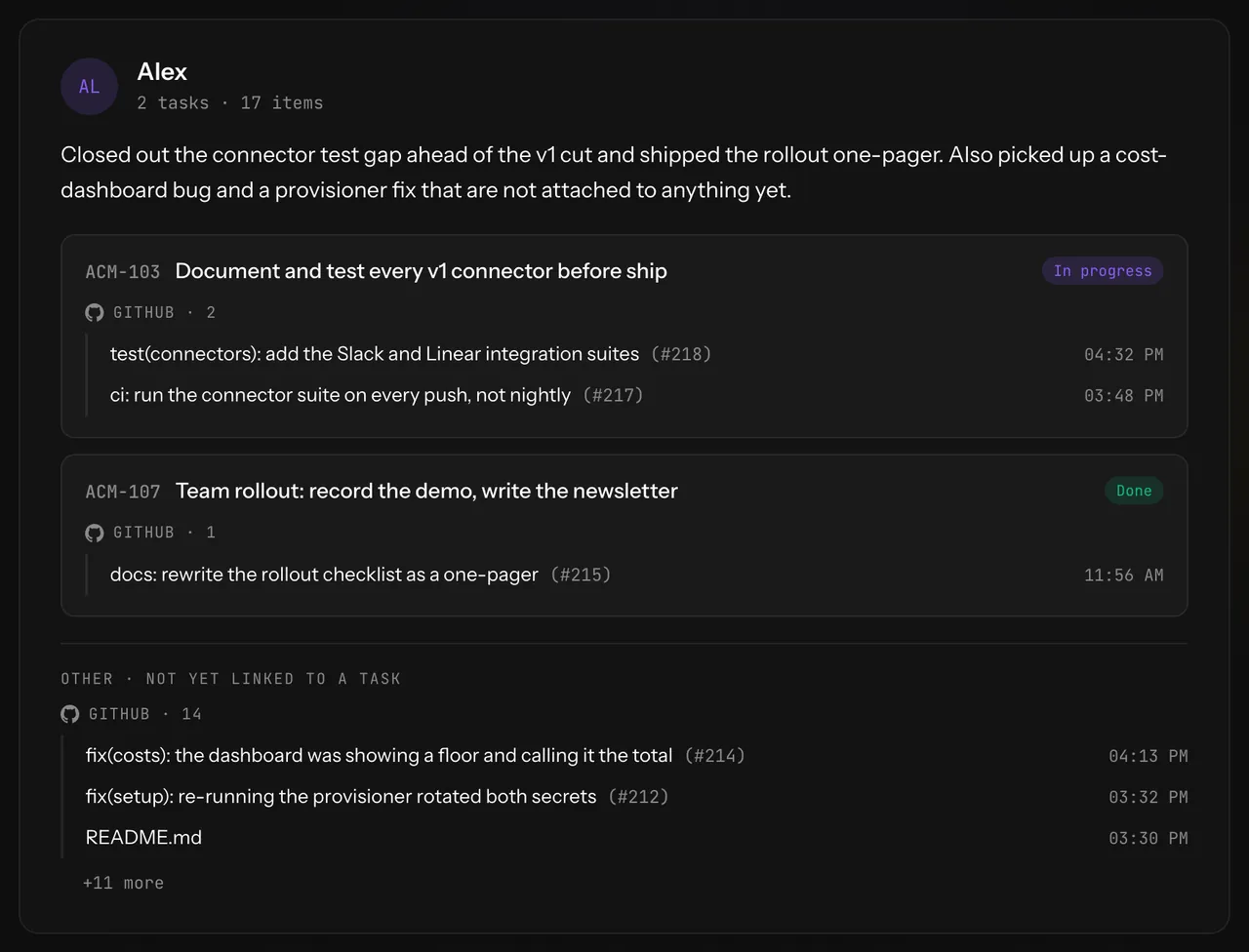
Nobody filed a status report. The summary on this card was written by the brain from the commits, tasks and threads as they landed. Underneath it is every item it was built from, grouped by the task it belongs to, so any sentence opens to what it rests on. The commits that belong to no task are listed too, rather than quietly dropped, because a tool that hides them looks tidier and is worth less.

A per-person timeline in the AIOS Team Brain: Alex, two tasks and seventeen items, a plain-English summary written by the brain, then the commits behind it grouped under each task with their PR numbers and times, and the commits not yet linked to a task listed separately
One person, one week. Nobody wrote any of this down.
THE INDIVIDUAL

And every person gets more agentic, not just busier.

Going agentic is not something a company does once. It is something each person gets better at, and most people have no idea whether they are getting better or just running more agents. The workspace makes that legible, and it does it on your machine.

Shared skills keep everyone in sync

Skills, harness configs and standards live in a team repo and version like code, so one person working out a better way to do something is not a thing the other four have to rediscover. You adopt it, you do not rebuild it.

You get told what to fix next

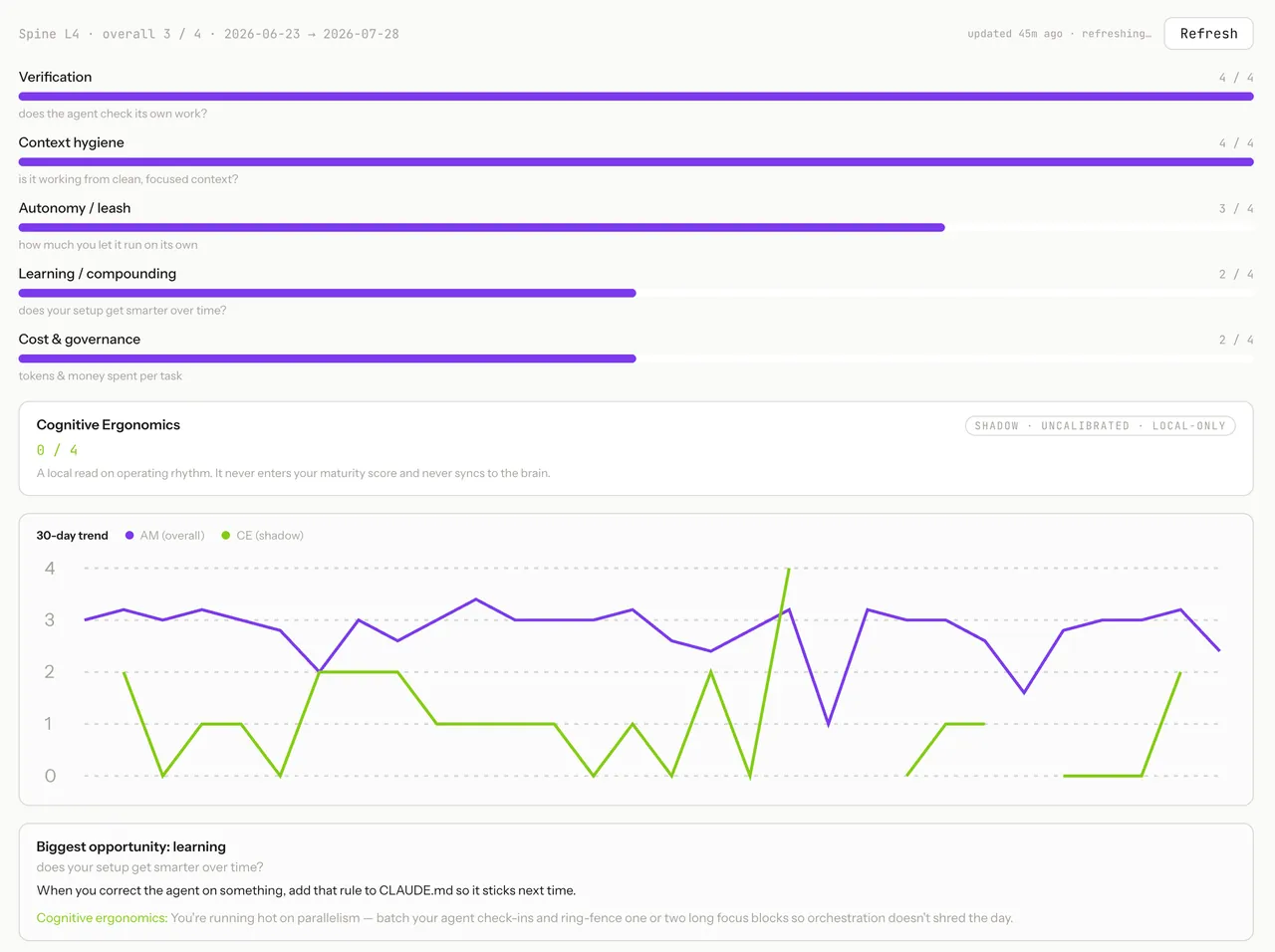
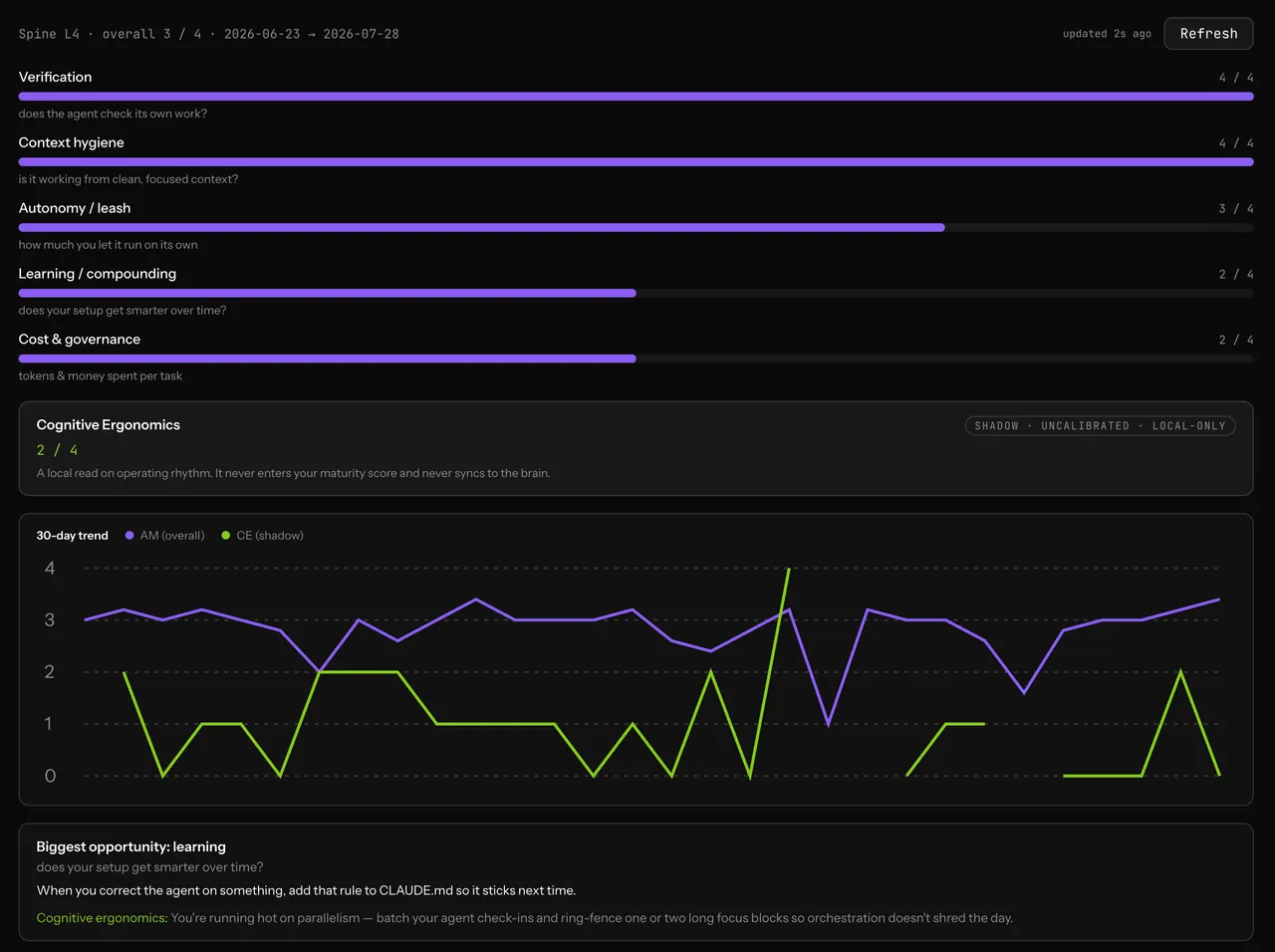
The workspace scores itself on the five things that decide whether agents compound, then names the weakest one and what to do about it. No guessing whether the transformation is working.

The AIOS workspace maturity panel: five scored dimensions with plain-English glosses (verification, context hygiene, autonomy, learning, cost and governance), a 30-day trend of the overall score, and a callout naming the biggest opportunity and what to do about it
Scored locally, on your machine. It never syncs unless you push it.
The system

Two halves. One loop.

Work flows up into a shared context layer; that ground truth flows back to every person and every agent. Everything anyone does becomes context the whole team can act on. That loop is the whole system, and the two halves are just its ends.

One operating system, instead of one per person.

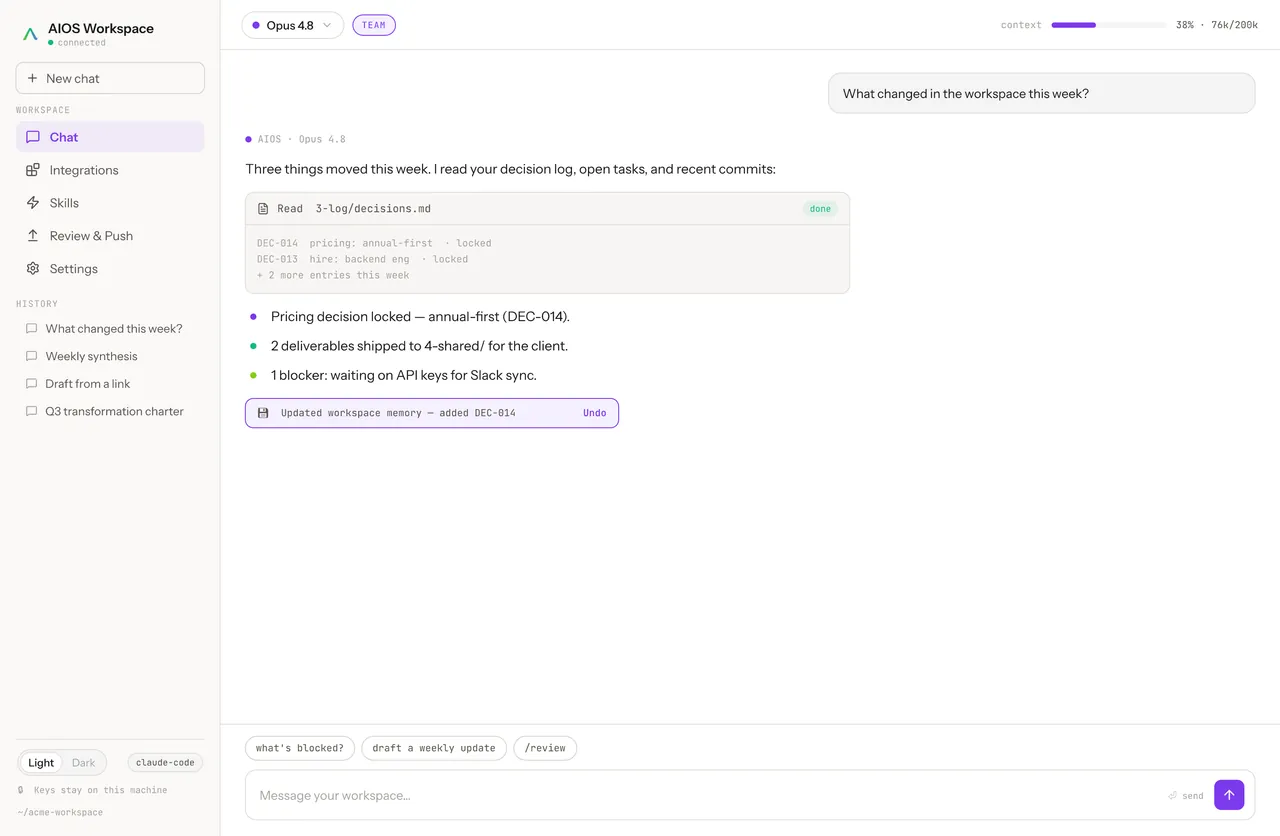
The AIOS workspace GUI: a numbered folder spine, harnesses, and governance rules for one person
FOR EACH PERSON

Individual Workspace

A home for you and your agents.

A structured, governed, versioned workspace that lives in your terminal, for one person and everything they run. Your prompts, your context, your tools, your outputs, organized instead of scattered across a dozen terminal sessions and chat windows.

It works alongside the harnesses you already use, Claude Code, Cursor, Codex, and the next one, instead of replacing them. Private by default: you decide what becomes team knowledge, and when.

  • Lives in your terminal: a structured CLI workspace, not another app to live in
  • Runs with your harnesses: Claude Code, Cursor, Codex, and whatever you run next, side by side
  • Governed and versioned: every change to your setup is tracked, not lost
  • Self hosted and MIT licensed: it runs on your machine, under your terms
Learn more →
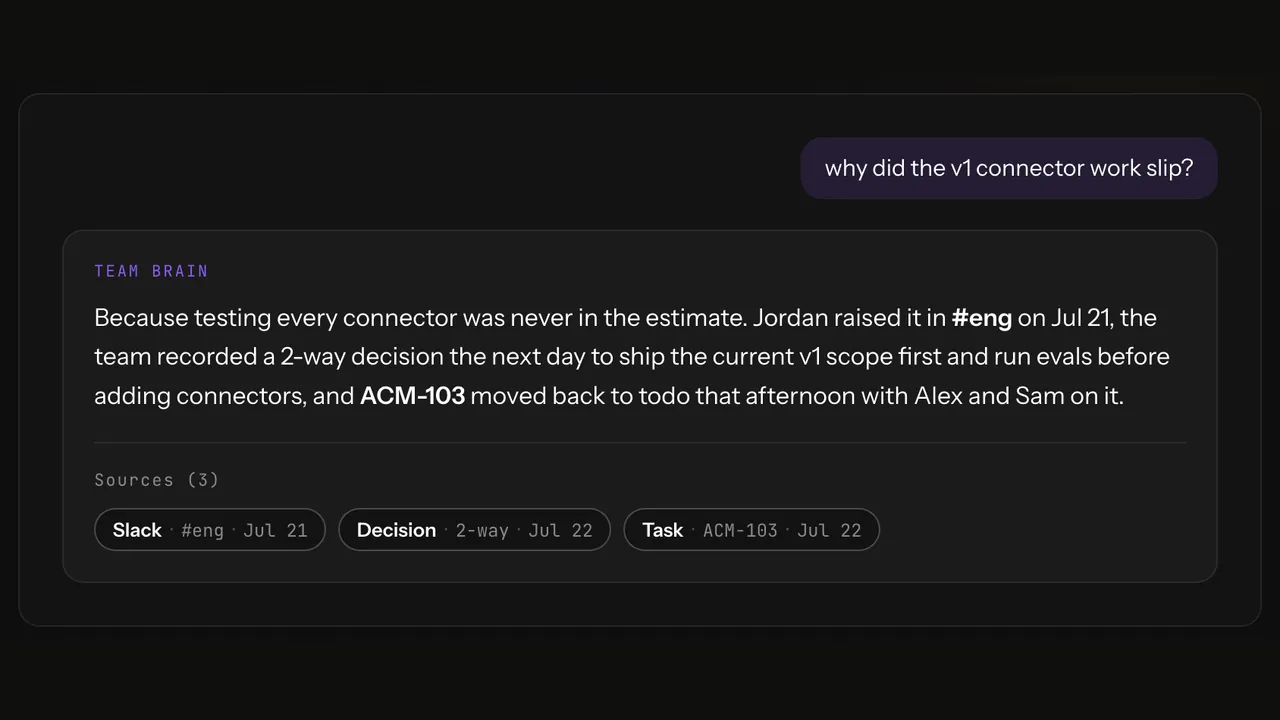
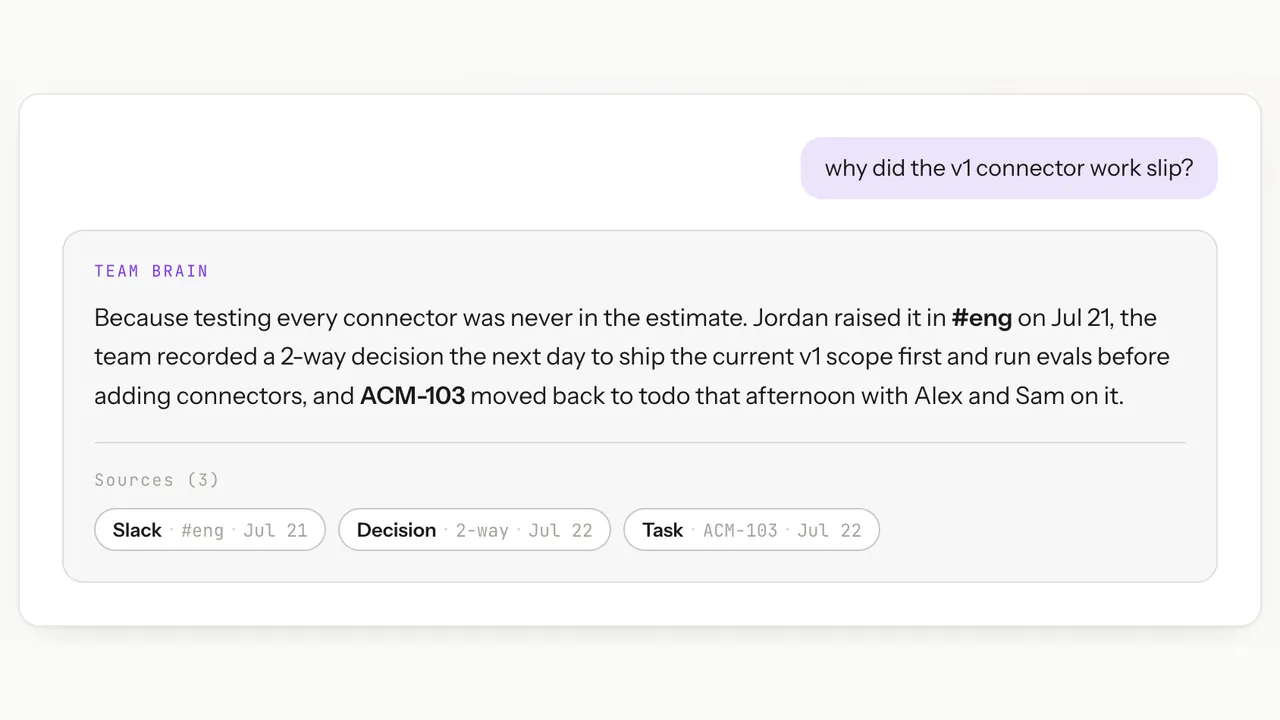
The AIOS Team Brain answering a plain-English question about why connector work slipped, with its three sources shown: a Slack thread, a recorded decision, and a task
FOR THE TEAM

Team Brain

A shared context layer for humans and agents.

It ingests everything the team produces, messages, documents, decisions, code, and context, and turns it into one robust context layer you can query like a colleague: a living substrate of ground truth, instead of knowledge scattered across a dozen tools.

That layer powers two things at once. Coordination, so people can see what others are doing and work together without status meetings. And automation, giving your agents a shared source of ground truth they can act against and keep up to date.

  • Ingests everything: messages, documents, decisions, and code become one queryable context layer
  • Coordination: see what the team is doing and where work overlaps, without status updates
  • Automation: agents act against shared ground truth and write their results back
  • Three tier privacy: admin, team, and external, so contributing never means over sharing
Learn more →
STRAIGHT ANSWERS

The questions you are actually asking.

Adopting something that sits at the centre of how your team works is a real commitment. These are the four objections we hear most, answered without hedging.

What if you stop building this?
Then you keep everything. The licence is MIT, the Team Brain runs on Postgres you host, and a workspace is plain files in a git repo you already own. There is no format to export from and no account to be locked out of, because nothing of yours lives anywhere we control.
Does our code and Slack leave our infrastructure?
No. You self-host the Team Brain, so the only infrastructure involved is yours. Nothing moves anywhere unless a person pushes it: every folder carries an access tier, the default is private, and the boundary refuses anything that has not been explicitly promoted. Three of the six folders in a workspace never leave the machine at all.
Why not just use Slack search and a shared doc?
Because neither one attributes work. Search finds messages if you already know what to look for, and a doc is only as current as the last person who remembered to edit it. The brain reads what actually happened, groups it by person and task, and shows the commits behind every sentence it writes.
How long does setup actually take?
Less than 15 minutes. You paste one prompt into a coding agent and it does the rest, stopping to ask before it writes anything and before it trusts a Brain URL. Nothing is installed on your machine until you approve it.

Getting started.

Paste one prompt into the coding agent you already use. It sets up both halves in the same run: your private workspace, and the Team Brain it pushes to.

It asks before it writes anything, and again before it trusts a Brain URL. Nothing lands on your machine, and nothing is shared, until you say so.

Read the full guide →

MIT licensed · Self hosted · Private by default