Open source · built in public

An Open Source AI Brain for Teams

Your team's shared brain — built from everyone's work. Each person runs an Individual Workstation for their own agents; what they choose to share flows into one Team Brain the whole team can query in plain English.

MIT-licensed and self-hosted — you decide what leaves your machine.
$ git clone --branch v0.10.0 --depth 1 https://github.com/aiosbrain/aios-workspace.git aios-workspace && test "$(git -C aios-workspace rev-parse HEAD)" = "5fded34256ad9e7eea4ad28ee50a8f24e1610dc8" && cd aios-workspace
$ scripts/scaffold-project.sh --context employee --slug my-workspace --owner you
$ aios push
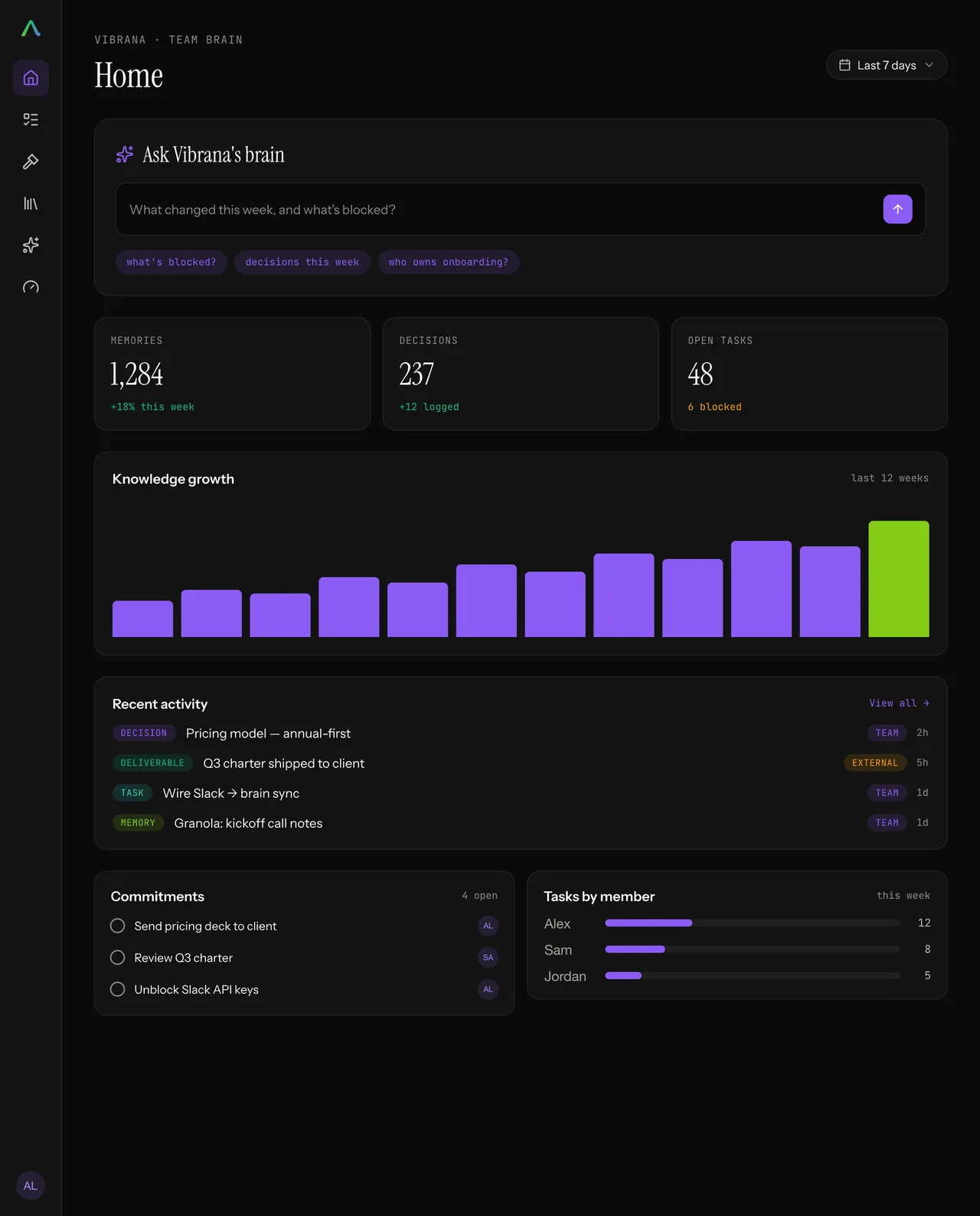
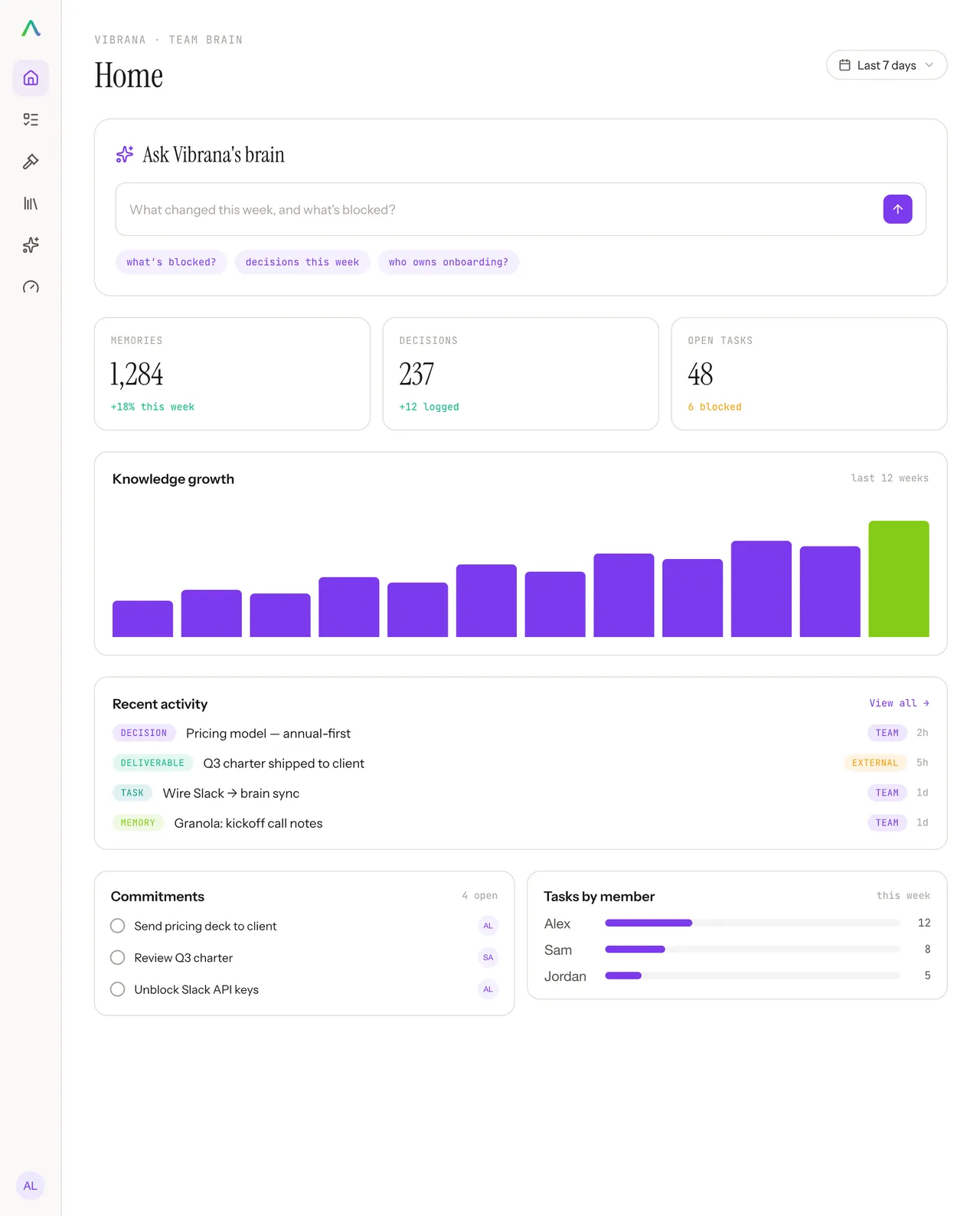
The AIOS Team Brain home — ask the shared brain in plain English, with KPIs, knowledge growth, and a live activity feed
10 Tools connected. Chat, code, docs, meetings.
3 Privacy tiers. Private by default.
100% Open source. MIT licensed.
THE PROBLEM

Working with agents is amazing. In a team, it breaks down fast.

Your organization already has a brain — scattered across Slack threads, stale docs, meeting notes, and the person who left six months ago. AIOS is the missing layer that makes collective intelligence queryable, actionable, and alive for agentic teams.

01

Context bloats.

Every agent's context balloons independently. No one on the team is working from the same picture.

02

Tools entangle.

MCPs, APIs, CLIs, and third-party sync tools pile up. Keeping them aligned costs more than the work itself.

03

Agents move 10× faster.

Contributors with agents outrun those without. The productivity gap creates chaos, not momentum.

04

The team loses the plot.

People tunnel into execution and drift from OKRs and customer needs. Speed in the wrong direction is waste.

What it's built on

The same values under both systems.

Before the workstation and the brain diverge, they share a foundation: a coordination layer you adopt piece by piece, with permission and privacy baked into the architecture from day one — not bolted on after.

P1

Modular

Each organ system is independently deployable. Adopt what you need: workspace only, brain only, or the full loop.

P2

Open source

MIT-licensed and self-hosted. Clone the workspace per person, run the brain on your Postgres. No cloud lock-in.

P3

Permissioned

Every action is policy-governed. Teams define what runs autonomously and what requires human approval.

P4

Privacy-first architecture

Individual agent data stays personal by default. The collective brain receives only what members choose to push.

The system

One loop, two organ systems.

The problem and the principles above are shared. Here's where AIOS splits: a private workstation for each person, and one shared brain for the team — joined by a single governed boundary.
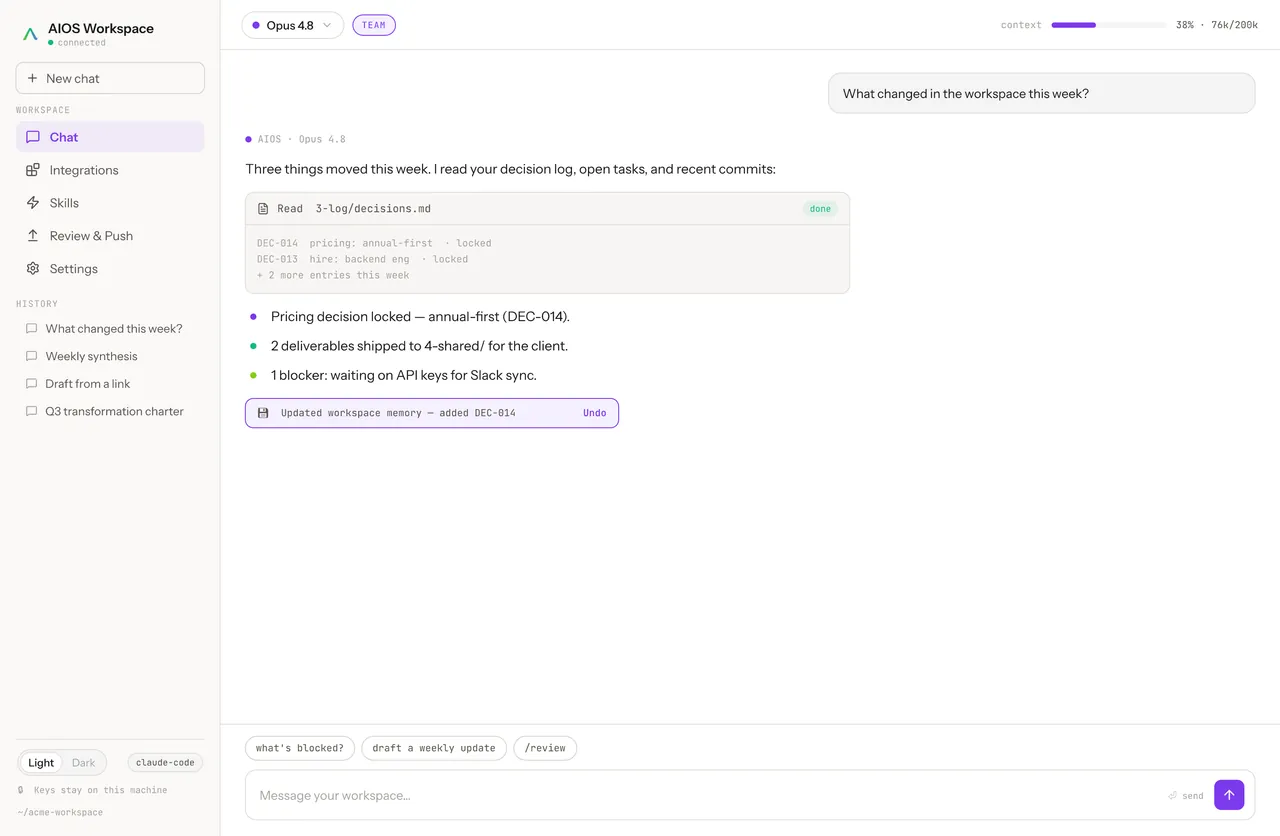
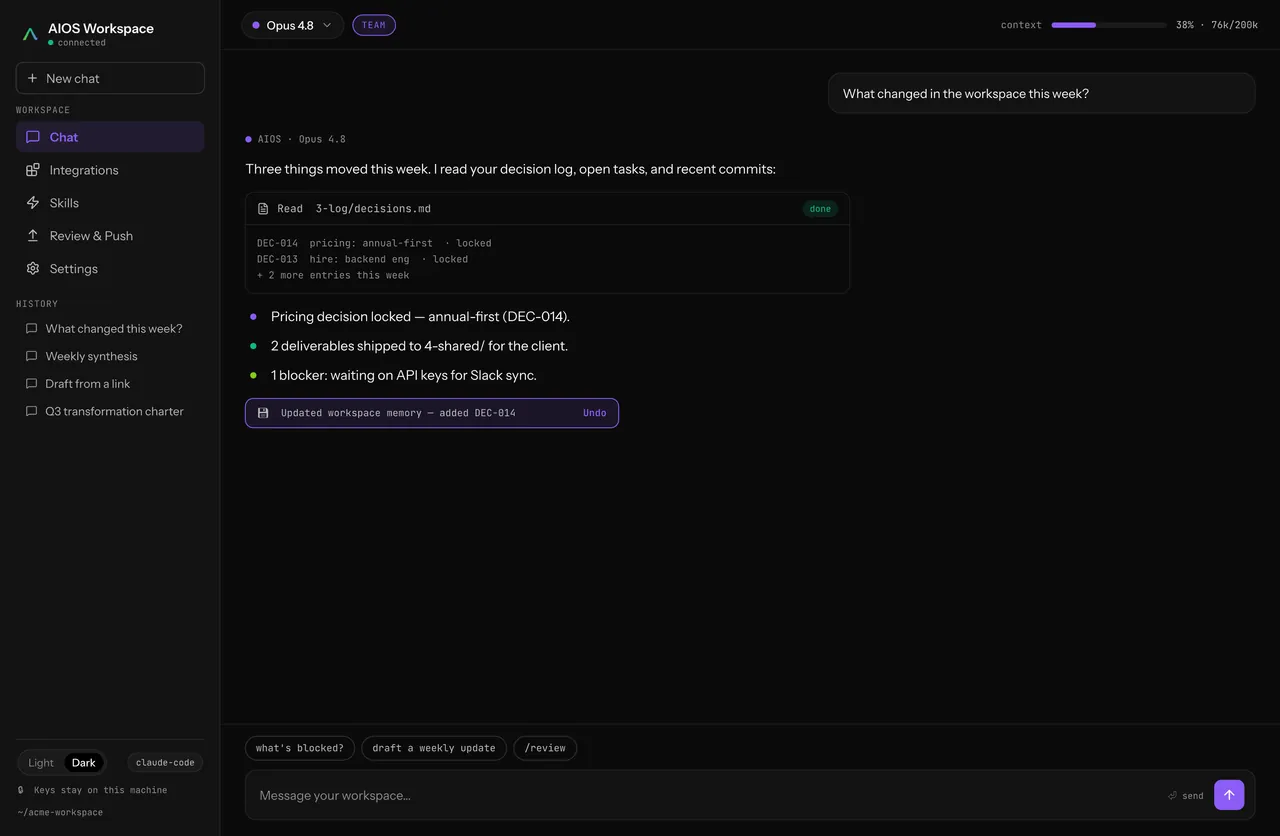
The AIOS workspace GUI — a numbered folder spine, harnesses, and governance rules for one person
ORGAN 01 · INDIVIDUAL

Individual Workstation

Your private agent workspace.

A structured home for one person and their agents — governed, versioned, and entirely yours. Nothing leaves it unless you push.

  • A numbered folder spine, governance rules, and validators — one per person.
  • Bring any agent — Claude Code, Cursor, Codex — and wire your tools over MCP + CLI.
  • Drive it from the terminal or the GUI. No terminal required.
  • Yours to run: MIT-licensed, self-hosted, no per-seat pricing.
The AIOS Team Brain home — plain-English query, KPIs, and a live activity feed across the team
ORGAN 02 · COLLECTIVE

Team Brain

Your team's shared memory.

One brain every workspace feeds — knowledge, decisions, and deliverables in a single queryable store that gets sharper with every push.

  • One shared memory, queried in plain English across the whole team.
  • Harnesses turn transcripts into decisions and ship weekly synthesis.
  • A kanban board, KPI dashboard, and policy-governed actions in one place.
  • Self-host it on your own Postgres.
The boundary between them

Nothing leaks without a push.

Private → team → external. The two systems meet at one governed gate. You promote content deliberately; the brain rejects admin-tier at the boundary with a 422. The Workstation stays yours — the Brain gets only what you choose to share, and grounded answers flow back within your tier.

The difference

Why not just use Claude and GitHub?

AIOS is the layer on top that helps to manage rapidly evolving context, harnessing and tooling. It wraps agents in a UI, provides shared memory, and unified governance, so your whole team can run them — not just the people who live in a terminal.

Claude Code + GitHub
AIOS
Who can use it
Engineers comfortable living in a terminal
Anyone — a UI puts the agent harnesses one click away
Agent harnesses
Wire up the prompts and glue yourself. Manage across multiple workspaces.
Create a shared harness for the entire team based on best practices.
Team memory
Per-repo, per-session, scattered across chats
One shared brain, queried in plain English
LLM cost & performance
Each person tracks spend and model choice alone, if at all
Per-member brain query spend in one dashboard today — unified cross-provider rollup (Anthropic, Cursor, etc.) on the roadmap
Sharing & privacy
All-or-nothing repo access
Tiered: private → team → external. Nothing leaks without a push
Structure
A blank repo and whatever conventions you remember
A numbered workspace spine, validators, and governance per person
Ownership
Your repos, your machines
Same — MIT-licensed, self-hosted, no new cloud
Getting started

Up in three steps.

# 1. Clone the stable release and scaffold
$ git clone --branch v0.10.0 --depth 1 https://github.com/aiosbrain/aios-workspace.git aios-workspace && test "$(git -C aios-workspace rev-parse HEAD)" = "5fded34256ad9e7eea4ad28ee50a8f24e1610dc8" && cd aios-workspace
$ scripts/scaffold-project.sh --context employee --slug my-workspace --owner you
$ cd ~/Projects/my-workspace
# 2. Run your first harness (in Claude Code)
$ claude
> /weekly-synthesis
# 3. Push to the team brain
$ aios push
Read the full guide →
Agentic Transformation

An operating system for humans and agents working together.

One structured place where humans and agents collaborate — built through practice of transforming 100+ companies. It protects privacy, preserves context, and surfaces the best patterns from any contributor to the whole team. Your tools, skills, and memory in a single system that gets smarter the more you use it.
Get the workspace →